Custom Aluminum Nitride Ceramic Parts & Components (AlN)
Custom manufacturing of high-thermal grade Aluminum Nitride components. Combining high thermal conductivity (170–190 W/m·K) with electrical insulation and a relatively low CTE suitable for electronic substrate and thermal-management applications where thermal expansion compatibility is an important design consideration.
Strategic Manufacturing Advantage
Our factory provides precise dimensional controls down to ±0.003 mm for AlN substrates and components, supporting integration into AI hardware and GPU packaging thermal designs.
Key Material Properties
Quantitative engineering data for design validation and material selection
Why Choose Aluminum Nitride?
AlN is the premier choice for thermal management in high-power electronics:
- Silicon-Compatible CTE: Thermal expansion coefficient (4.3 - 4.6 x10⁻⁶/K, typical 4.5 x10⁻⁶/K) is closely compatible with silicon wafers, helping reduce thermal stress in power module packaging. Typical values may vary by grade and test condition.
- High Thermal Conductivity: 170-190 W/m·K (typical 180 W/m·K) approaches that of many metals while maintaining strong electrical insulation (>10¹⁴ Ω·cm).
- High-Frequency Performance: Low dielectric constant (εr ≈ 8.8) and minimal dielectric loss tangent make AlN ideal for RF and microwave applications.
Why Is Aluminum Nitride Used for Thermal and Electrical Applications?
Aluminum nitride (AlN) is used for thermal and electrical applications requiring high thermal conductivity (170-190 W/m·K) combined with electrical insulation (>10¹⁴ Ω·cm). Unlike metals that conduct both heat and electricity, AlN transfers heat efficiently while maintaining dielectric isolation, making it suitable for power module substrates and chip carriers. Its CTE (4.3-4.6 ×10⁻⁶/K) is compatible with silicon, reducing thermal stress in electronic packaging. Precision machining to ±0.003 mm enables thin substrates (down to 0.3 mm) with metallization-ready surfaces (Ra 0.05 μm) for DBC assembly in AI hardware, RF infrastructure, and semiconductor processing equipment.
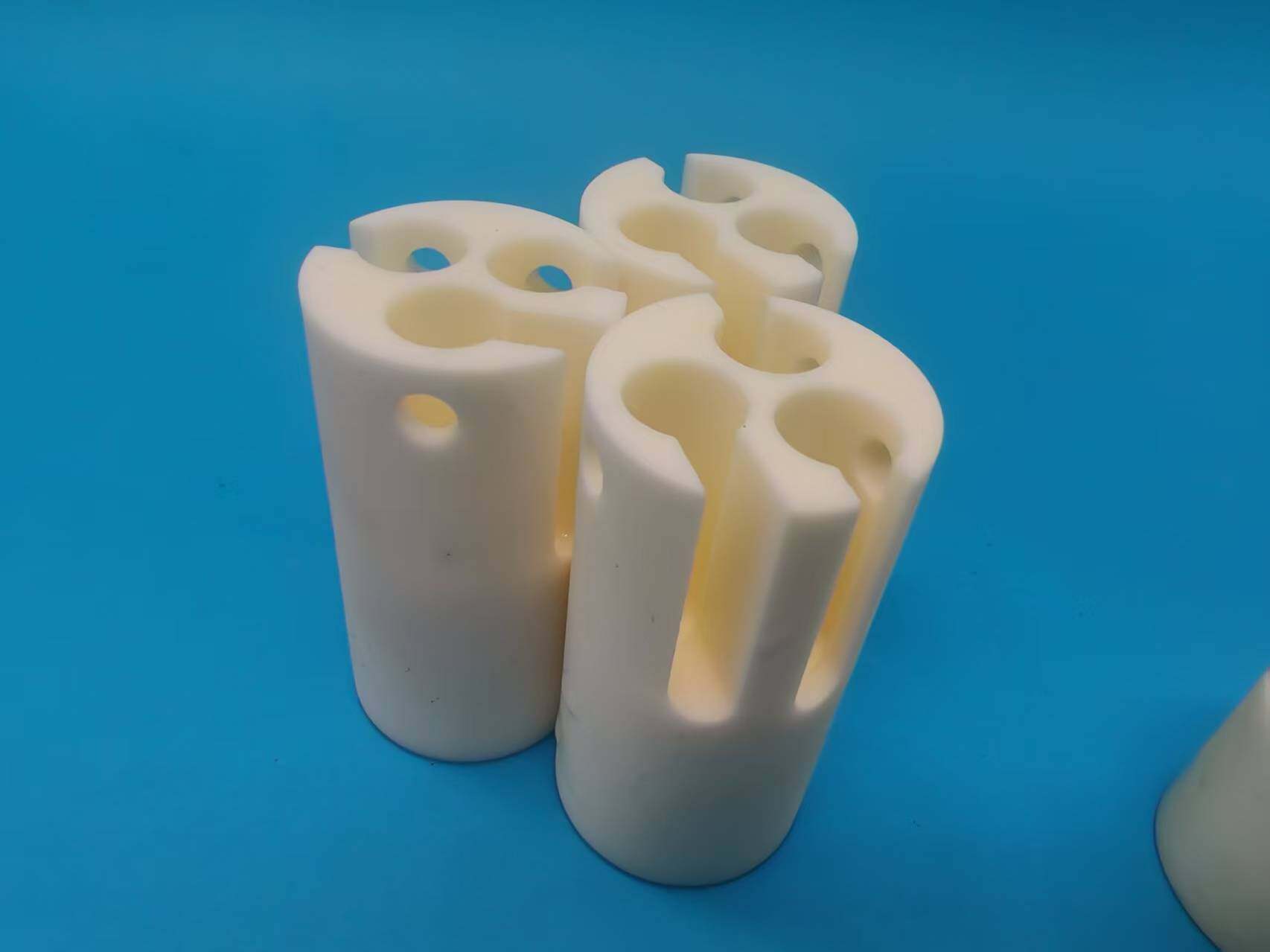
Precision Aluminum Nitride Ceramic Parts
High-Value Applications
Proven performance in AI hardware, RF wireless, optoelectronics, and semiconductor processing
AI Hardware & Computing Infrastructure
- •High-power GPU/TPU chip carrier submounts
- •Micro-electronic heat sinks
- •Thermal blocks
- •Power module substrates
RF Wireless & Optoelectronics
- •High-frequency RF wireless infrastructure insulators
- •Laser diode submounts
- •Optical transceiver bases
- •Microwave package headers
Semiconductor Wafer Processing
- •Precision heater plates
- •Electrostatic chuck components
- •Plasma chamber insulating tabs
- •Wafer stage mirrors
Typical Mechanical & Thermal Properties
Reference data for High-Thermal Grade AlN at room temperature
| Property | Test Method | Unit | Value |
|---|---|---|---|
| Density | ISO 2738 | g/cm³ | 3.28 |
| Flexural Strength | ISO 14704 | MPa | 310 |
| Young's Modulus | ISO 17561 | GPa | 310 |
| Vickers Hardness | ISO 6507 | HV0.5 | ≥ 1000 |
| Fracture Toughness | ISO 23146 | MPa·m½ | 2.5 - 3.0 |
| Thermal Conductivity | ISO 22007 | W/m·K | 180 |
| Coefficient of Thermal Expansion | ISO 11372 | x10⁻⁶/K | 4.5 |
| Dielectric Strength | IEC 60243 | kV/mm | ≥ 15 |
| Volume Resistivity | IEC 60243 | Ω·cm | > 10¹⁴ |
| Max Service Temperature | Continuous | °C | 1400 |
Why Engineers Select Aluminum Nitride: Property-to-Function Relationships
How material properties translate into engineering performance for precision ceramic components
High Thermal Conductivity (170-190 W/m·K)
→ Efficient Heat Transfer
Transfers heat from power devices while maintaining electrical insulation, approaching metal-like thermal performance in dielectric substrate applications.
Silicon-Compatible CTE (4.3-4.6 ×10⁻⁶/K)
→ Thermal Expansion Matching
Reduces thermal stress in silicon chip carriers and power module packaging, improving reliability during temperature cycling.
High Volume Resistivity (> 10¹⁴ Ω·cm)
→ Electrical Isolation
Maintains dielectric isolation at high frequencies, suitable for RF infrastructure and power electronics substrates where signal integrity is critical.
Low Dielectric Constant (εr ≈ 8.8)
→ High-Frequency Performance
Minimal dielectric loss at microwave frequencies supports RF wireless infrastructure and high-speed electronic packaging applications.
Precision Machining Considerations for AlN
Manufacturing capabilities and engineering considerations specific to aluminum nitride ceramics
±0.003 mm Dimensional Control
Ultra-precision grinding and lapping achieving tight tolerances critical for chip carrier flatness and thermal interface contact.
Thin Substrate Processing
Machining of thin AlN substrates (down to 0.3 mm thickness) without fracture, enabled by optimized fixturing and stress-free grinding parameters.
Metallization-Ready Surfaces
Ra 0.05 μm surface quality ensures reliable thick-film or DBC (Direct Bonded Copper) metallization adhesion for power module assembly.
Micro-Via & Through-Hole Drilling
Diamond micro-drilling for thermal vias and electrical feedthroughs down to Ø 0.2 mm with clean edges and minimal chipping.
Large-Format Plate Grinding
Precision surface grinding of large AlN plates (up to 200mm x 200mm) with parallelism ≤ 0.005 mm for uniform thermal distribution.
Complete Traceability Documentation
Full FAI/OQC reports including thermal conductivity verification, dimensional datasheets, and material certificates (MTR/CoC).
Inspection & Verification for AlN Components
Matching component features to appropriate inspection methods ensures dimensional accuracy and surface quality
| Component Feature | Inspection Method | Capability |
|---|---|---|
| Flatness / Parallelism (≤ 0.005 mm) | Flatness Measurement | Optical flat for substrate verification |
| Critical dimensions (±0.003 mm) | CMM / Video Measurement | Full 3D coordinate measurement |
| Surface finish (Ra 0.05 μm) | Roughness Measurement | Contact profilometry for metallization prep |
| Thin substrate thickness | Micrometer / CMM | Precision thickness measurement |
| Micro-via holes (Ø 0.2 mm) | Video Measurement System | Non-contact optical hole measurement |
| Height / Step dimensions | Trimos Height Gauge | Precision vertical measurement |
Engineering Considerations
Achievable tolerance, surface finish, and feature size depend on:
- Material grade
- Part size
- Geometry complexity
- Feature location
- Aspect ratio
- Surface requirements
- Inspection method
- Batch quantity
Validate Your Aluminum Nitride Component Design with Korecera
Submit your 2D engineering blueprints or 3D CAD files (.STEP / .IGS) below. Our expert engineering team will conduct an in-depth Design-for-Manufacturability (DFM) review and deliver a competitive direct-factory quote. Fast-track prototyping completed within 7-10 business days. Full FAI, OQC, and material traceability reports provided upon delivery.
100% Strict NDA Protection Enforced